Jansbar and Pakhuis
“Lust, an intense longing. Lust for power, money or control. Or simply lust for another person. The Janskerkhof, where lovers used to meet, is still filled with it, particularly when the sun goes down and people of the night come seeking out their own lusts. This can be seen at The Jansbar and Het Pakhuis. Do you dare to let your desire roam free here at night?”
One of the sins, lust, found its way back many years. Sodomist men met up in numerous places in Utrecht, one of them being the Janskerkhof. The act of sodomy, sexual handling between people of the same sex, was seen as not only a heavy sin but as a crime as well. It was defined as a crimen nefandum - a crime one should not speak of. Even the naming of the sexual actions was avoided. The first trial against someone accused of sodomy in Utrecht dates back to 1352 (Noordam, 1990). A notorious trial against sodomy begins in 1797, where four men where arrested accused of sodomy. There is no record of any trials against women. This trial in Utrecht created a snowball effect in the persecution of sodomites throughout the entirety of the Netherlands, leading to the death of almost 100 men. The youngest of these men was only 14 years old (Deen, 2014). Often when people did not confess, the torture rack was used. This was only forbidden in 1789, the sodomy persecution stopped in 1811 when a Code Penal no longer made sodomy punishable (Tigelaar, 1996). These trials represent one of the blackest pages in the history of jurisdiction.
Lust is still around Janskerkhof. Today, it can be found around one of the bars, for example the Jansbar and het Pakhuis. At night, people meet there to flirt and find a fling. This is illustrated by one of the reviews on Google Maps, where someone wrote: “An amazing bar. If you like to go wild with your friends to thereafter kiss a girl, definitely come to the Pakhuis. From 12-3 it is very fun. After that, the drunk ladies come in and the name of the club gets the name right (Pakhuis stands for grabhouse, roughly translated). Grabbing!”.
PHRM
“Gluttony, the overindulgence. Consuming more than one can handle, even to the point of mere waste. In a wealthy society, where sources are plentiful, people stop thinking about what they need and just take what they want. The student fraternity shows examples of this, particularly at night, when overindulgence of alcohol is displayed around the PHRM building.”
PHRM, the building of the student association Utrechts Studenten Corps, has been at the Janskerkhof since 1899 (Huizen aan het Janskerkhof, n.d.). The USC has also brought some nuisance to the Janskerkhof. The once so holy church found itself a popular peeing spot for druk students. In 2016, the Janskerkhof had the highest amount of fines for urinating in public. Ever since members from the USC would be sanctioned with being dismembered from their student association, the problem has been largely resolved (Cazander, 2016).
Streetfood Club
“A desire, a lust for material possessions. Acquiring more than you need - a problem modern society deals with. When do we stop, when is it enough? Where once used to be Cafe Zussen, now is the Streetfood Club - a hip hotspot. But what about the owners it drove out, the Cafe that was there for such a long period? Does everything have to be hipper, gentrified, trendier?”
De Oude Tijd
“Being indifferent, a passive attitude. Those words define sloth, as do they define the Cigar Shop on the corner where two men sit outside, doing nothing. The smoking in itself is an absent care for its own body -- the smoker has the desire to smoke, regardless of the harmful effects. Just try to sit next to the shop for a moment -- what do you see, are there any sinners?”
Lorem ipsum dolor sit amet, consectetur adipiscing elit. Donec nec varius risus. Nullam mollis ac odio blandit tristique. Pellentesque nec neque ac odio iaculis tempor et sollicitudin quam. Nulla in porta nulla. Donec ornare sapien arcu, ut luctus purus tristique in. Praesent mollis tincidunt tempus. Fusce aliquet hendrerit metus a imperdiet. Vivamus ullamcorper finibus placerat. Vestibulum id viverra felis, et malesuada dui. Nulla eu purus sapien. Curabitur fringilla enim a risus mollis feugiat. Proin ac risus quis dui lobortis tincidunt sed sit amet ipsum. Etiam nec tortor eu tellus pretium consequat non malesuada purus. Pellentesque et ipsum tortor. Mauris imperdiet.
Murders on Janskerkhof
“Wrath, destroying everything in its way. Uncontrollable anger. Is it a sin from the past, or do the fights at night still resemble wrath?”
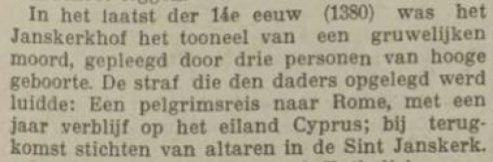
In 1380, a gruesome murder took place at the Janskerkhof. Three people murdered a man because of a very greedy issue - money. As punishment, they had to go on a pilgrimage to Rome and return to the Janskerkhof to make a shrine (Huizen aan het Janskerkhof, n.d.). The picture below is from a newspaper, retrieved from the Utrecht Archives.
Broodje Carlo and Broodje Mario
“Insatiable desire, wanting someone else's possessions. What better way to show this than the sandwich war between Broodje Mario and Broodje Carlo? They both sell the same thing, right next to each other. Can’t one of them just move somewhere else, or are they caught up in a whirlwind of envy?”
Two slices of salami, two slices of chorizo, some vegetable strips, cheese and a green pepper. It might not sound that controversial, but it has been the source of the ongoing competition between Broodje Mario and Broodje Carlo: two Italian sandwich shops, located right next to each other at the Janskerkhof. They sell the same standard Italian sandwich, use the same ingredients, charge the same price (€3,-) and enjoy the same popularity. What are the origins of this Italian ‘sandwich-war’?
It is important to notice that these are not the only Italian sandwich shops in Utrecht. At the Oudegracht, another stall with the name ‘Broodje Mario’ has dominated the area for years. Another Italian entrepreneur, Carlo Stamegna, tried his luck at the Janskerkhof by opening his sandwich shop Pizzaria della Casa - better known as ‘Broodje Carlo’ to the general public. But thriving business at the Janskerkhof did not go unnoticed, and Carlo would soon receive fierce competition from an experienced shop owner. After years of Carlo’s exclusive rights at the Janskerkhof, another sandwich shop opened up a few metres next to Broodje Carlo: straightforwardly called ‘Broodje Mario 2’.
Carlo complained to the municipality that his neighbour did not respect the existing rules for kiosks at the square and accused Mario of other illegal activities. On the other hand, Mario was unaware of any wrongdoing, and claimed that he was the rightful claimant of Italian sandwiches in Utrecht: “We have been located in Utrecht for more than thirty years. Everybody knows us. We have popularized the Italian sandwiches in the Netherlands. Nobody else. The Netherlands has a free market. Period.” (2010) The yes/no debate between Carlo and Mario seems unsolvable and continues until this day. Only the future knows how this envious competition between two Italian sandwich shops at the Janskerkhof will eventually turn out.
University Buildings
“Dangerously corrupt selfishness. Wanting to show off, let everyone know that you are better. Is that what the University of Utrecht is trying to do with its buildings? From the gold in the arches to the stately doors. They are certainly not trying to hide their presence.”
The dark colonial past of the Netherlands is reflected in the seventeenth-century city palaces that were built at the Janskerkhof. After being transformed from a clerical immunity to a public domain during the Reformation, the lots surrounding the Janskerkhof were bought by rich burghers. To express their wealth, they imported different ornamental stones from all over Europe. The ornamental stones used in most University buildings are often Belgium ‘Hardsteen’. If you look closely, you can find fossils of coral types and other sea-creatures. For example, you can take a look at the stairs at the entrance of Janskerkhof 12, where you can see fossils dating back to the devonian era.